Why Your Rolling Forecast Is Always Stale

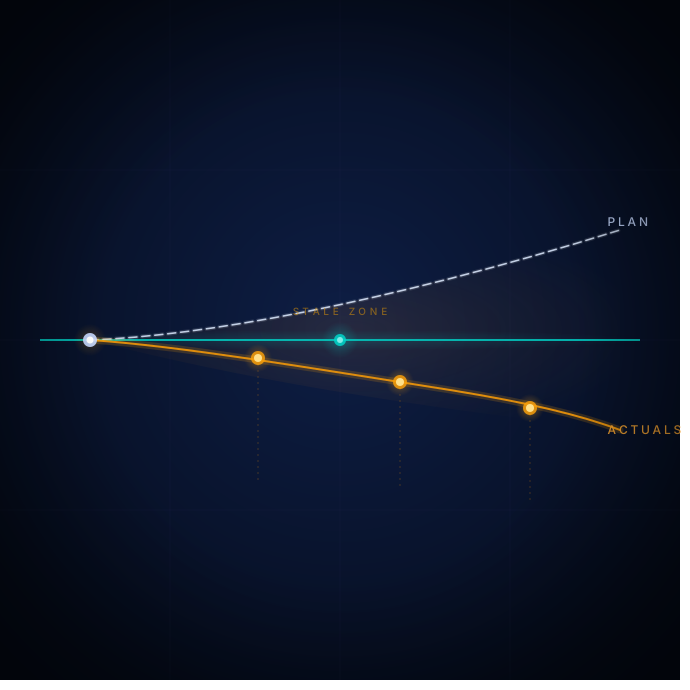
Every FP&A team knows the feeling. The reforecast was published on Monday. By Wednesday, someone in sales has closed a deal that changes the revenue picture. By Friday, procurement has flagged a cost overrun that nobody modelled. The forecast is four days old and already partially wrong.
This is not a forecasting problem. It is a data pipeline problem. Finance teams hired analysts for their analytical skills. Instead, they have become data janitors - Monday pulling data from five systems, Tuesday reconciling discrepancies, Wednesday actually analysing, Thursday fixing errors, Friday delivering late. And most FP&A teams are treating the symptom rather than the cause.
The symptom everyone talks about
The rolling forecast is supposed to be a live view of where the business is heading. In practice, it is a quarterly document built on monthly data exports, assembled in a planning tool that was last refreshed three weeks ago, by a team that spent most of its time collecting the numbers rather than thinking about them.
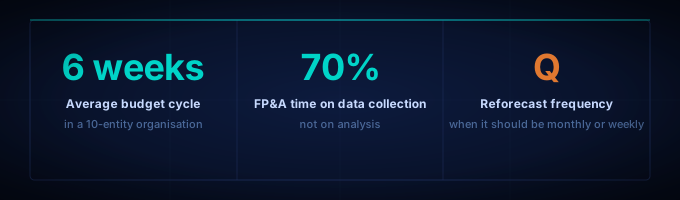
When the board asks whether the full-year forecast is still valid, the honest answer is: it was valid when we built it. That was six weeks ago.
The forecast is not stale because FP&A teams are slow. It is stale because the data pipeline feeding the forecast was never built for speed.
Four root causes - and why fixing one without the others does not work
01: Actuals live in a different system than the plan.
The budget was built in Anaplan or Planful. Actuals come from the ERP. Connecting them requires a manual export from the ERP, a data transformation step, and an import into the planning tool - usually done by one person, usually monthly, usually at the start of a week that is already full. Until that import happens, the plan and actuals are disconnected. Variance analysis is not possible. The forecast cannot be updated. In a multi-entity organisation, the manual version of this looks like a board question about the project pipeline triggering a round-trip to 10 or 15 entities, each returning an Excel file, each in a slightly different format. The analysis arrives two days after the question was relevant.
02: Operational drivers are not connected to the financial model.
A rolling forecast is only as good as the drivers feeding it. Headcount changes in Workday. Pricing changes in the CRM. Volume data in the ERP. In most organisations these systems are not connected to the planning layer. When a sales leader asks whether the current headcount plan is consistent with the revised revenue forecast, the answer requires someone to manually pull data from three systems and build a bridge that did not previously exist.
03: The reforecast cycle is too expensive to run frequently.
Updating the forecast requires re-running the data collection cycle: extract actuals, transform, import, reconcile against plan, rebuild the variance commentary. In a multi-entity organisation that process takes days. For teams blending 17 or more manual data sources, it consumes most of the week. Most FP&A teams run it quarterly because monthly would consume too much capacity. Weekly is not even on the table. The result: a reforecast cadence determined by operational cost rather than by what the business actually needs. At mid-market scale, the annual cost of sustaining this manual consolidation layer runs above $850,000 - not in licence fees, but in analyst time.
04: Plan and actuals use different definitions of the same metrics.
The budget was built using a gross margin definition that excludes allocated overhead. Actuals from the ERP include allocated overhead in the cost base. The variance analysis shows a 4-point margin miss that is partly real and partly a definitional artefact. Figuring out which part is which requires someone who knows both systems well enough to spot the difference - and that person is not always available when the board is asking the question.
What changes when the data pipeline is automated
The reforecast cycle is expensive because each step requires human intervention: data collection, transformation, reconciliation, import. Automate those steps and the cost drops to near zero.
When actuals flow from every ERP into the planning layer automatically - at journal-entry level, mapped to the planning structure, reconciled against the governed chart of accounts - the reforecast is not a project. It is a refresh. Finance teams describe this shift as moving from a quarterly fire drill to a continuous close: the books are kept current, period-end is a confirmation rather than a construction, and the FP&A team reviews variance output rather than building it.
What this makes possible:
- Weekly reforecasts without additional headcount. The pipeline runs on a schedule. The FP&A team reviews the output rather than producing it.
- Operational drivers connected to the financial model. Headcount from Workday, volume from the ERP, pricing from the CRM - all feeding the plan automatically. When headcount changes, the cost model updates. When volume falls, the revenue forecast adjusts.
- Variance analysis that starts from data, not from a reconciliation exercise. Actuals and plan use the same definitions because they draw from the same governed layer. The 4-point margin variance is real or it is not - there is no definitional ambiguity to unpick first.
- A reforecast cadence determined by what the business needs, not by what the data pipeline can sustain.
- And a less visible benefit: the analysts stay. Finance teams are losing senior people to companies with better tooling. The manual export cycle is not just inefficient - it is the reason good analysts leave. A team that spends 70% of its time on data collection is not a place experienced FP&A professionals want to work.
Home Credit reduced FP&A reporting time by 70% across 9 countries. The team did not shrink. The data collection work disappeared - and the analysis work expanded to fill the space.
The question to ask about your current process
If you updated your rolling forecast today - not next month, today - how long would it take? How many manual steps? How many systems to extract from? How many reconciliations before the numbers are trustworthy?
If the answer is more than a day, the constraint is not your team's analytical capability. It is the data pipeline underneath the forecast.
The fix is not a better planning tool. Anaplan, Planful, and Pigment are all capable of producing excellent forecasts - if the data feeding them is current, governed, and connected to the operational reality of the business. The planning tool is the last mile. The data pipeline is the road.
Not sure where your pipeline is breaking down? That is exactly what the 30-minute review is for. We map your current actuals flow and show you where the stale data is entering the forecast.
Related
- Home Credit customer story: 70% FP&A time reduction, 9 countries
- Financial Close, Reimagined: The Numbers You Cannot Trust (whitepaper)
- Guessing AI vs. Verifiable AI: Why the Difference Matters in Finance (blog)
Newsletter
Get more like this in your inbox
Practical data engineering and AI insights from the Keboola team.


