Guessing AI vs. Verifiable AI: Why the Difference Matters in Finance

I asked Claude what the cash position would be at year-end. The answer was about 30% off.
A CFO said this at a finance leaders breakfast in Prague. Almost every CFO in the room had a version of the same story.
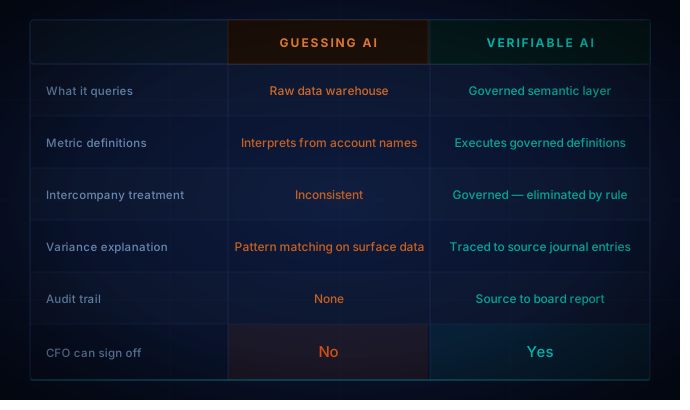
The problem is not the model. Claude is not bad at maths. The problem is what the model was reasoning over - raw financial data with no governed definitions, no intercompany rules, no agreed methodology for what 'cash position' means at that specific company.
This is the difference between guessing AI and verifiable AI. In most finance deployments today, it is guessing.
What happens when AI queries undefined financial data
Ask your AI tool what your EBITDA was last quarter. Watch what it does.
If it is connected to your raw data warehouse, it will find accounts that look like they belong in an EBITDA calculation, add them up, and give you a number. The number will be presented with confidence. It may be materially wrong.
Why? Because EBITDA is not a universally defined concept at the account level. Your company has made decisions about which accounts to include, which intercompany transactions to exclude, how to treat certain depreciation categories. Those decisions live in the heads of your finance team, in a shared spreadsheet, or in an FP&A model nobody outside the team can access.
The AI does not know about those decisions. It makes reasonable assumptions. In finance, reasonable assumptions on top of ungoverned data produce results that are technically defensible and operationally wrong.
Three examples of guessing AI
Revenue that includes intercompany sales.
The AI finds all accounts tagged as revenue and adds them up. It does not know that two of those accounts represent intergroup transactions that should be eliminated at consolidation. The number is 8% higher than the real number. The CFO quotes it at a board meeting.
Gross margin calculated against the wrong cost base.
Finance defined gross margin as revenue minus direct production costs, excluding allocated overhead. The AI includes allocated overhead because it cannot distinguish between the two from account codes alone. During a workshop, a controller and a sales director realised they had been looking at different gross margin figures for months - each pulling from a system that applied a different definition. Neither knew the other was wrong. The product team had made a pricing decision based on one of them.
A variance explanation that identifies the wrong driver.
The AI spots that payroll cost in Germany increased 12% quarter on quarter and flags it as the primary margin driver. It does not know that the actual driver was a one-off restructuring charge coded to a general payroll account. The narrative goes to the board. The restructuring charge is not mentioned.
What verifiable AI looks like instead
Verifiable AI is not a different model. It is the same model connected to a different foundation.
The foundation is a governed data layer with a business glossary that defines every financial metric in terms your company has explicitly agreed on. EBITDA is not a word the AI interprets - it is a formula linked to specific accounts, with specific exclusions, owned by a specific person in finance. When the AI queries EBITDA, it executes that formula. The answer is the same answer your controller would produce manually. It is traceable to source journal entries. It can be audited.
You can tell when the AI is guessing and when it is giving you a verifiable answer grounded in your company's own metric definitions.
The same three examples - with a governed layer
Revenue that excludes intercompany sales.
The business glossary defines revenue as the sum of accounts 4000-4999, excluding accounts tagged as intercompany in the entity dimension. The AI executes the definition. The elimination is automatic.
Gross margin calculated against the right cost base.
The governed definition of gross margin explicitly excludes allocated overhead accounts. The AI applies the definition. The number is one the finance team and the product team can both stand behind.
A variance explanation that traces to source.
The AI identifies that payroll cost in Germany increased 12%. It traces the variance to the specific journal entries that drove it - a restructuring charge posted on 14 March. The narrative includes the charge. The board sees the real picture. A finance leader at DFDS described this as 'the dream scenario and most significant value-add' - AI that does not just say what happened, but traces why, to source.
The comparison
The foundation matters more than the model
Finance teams spend most of their time comparing AI models - Claude vs Copilot vs Gemini - and not enough time asking what the model will be connected to.
A weaker model connected to a governed data layer will consistently outperform a stronger model connected to a raw warehouse. Because the stronger model makes better guesses - but they are still guesses.
Before deploying AI in finance, the question is not which model to use. It is whether the data the model queries has governed definitions, a clean account structure, and intercompany elimination rules. If the answer is no, any AI deployment is a risk, not a capability.
The AI is only as trustworthy as the data it reasons over. Every number in a glass box - that is the guarantee.
What this means in practice
Step 1:
Build the governed financial data layer first. Clean accounts, defined metrics, intercompany rules encoded. This is not an AI project - it is the prerequisite for one. Home Credit built this across 9 countries. The result: 70% reduction in FP&A reporting time, with 25% of all HQ reporting running automatically.
Step 2:
Then connect the AI through the semantic layer, not directly to the warehouse. The first time the AI returns a number, trace it to the source journal entry. Once that trace holds, you have verifiable AI. The CFO can sign off. The board can drill in. The audit question has an answer.
Related
- Business Glossary: keboola.com/business-glossary
- AI Agents - Audit and Controlling: keboola.com/ai-audit-controlling
- Home Credit customer story: 9 countries, 70% FP&A time reduction
- Financial Close, Reimagined: The Numbers You Cannot Trust (whitepaper)
Newsletter
Get more like this in your inbox
Practical data engineering and AI insights from the Keboola team.


