

Financial planning, budgeting and forecasting — continuous, not cyclical.
Keboola makes planning, budgeting and forecasting continuous: budgets built on traceable actuals harmonized across every entity and ERP, Monte Carlo what-if simulation with P10–P90 bands (now in preview), and agents that keep watching after the board approves. Reforecast weekly, not quarterly. You do not need a clean data layer before you start.
Trusted by 1,000+ companies


The Problem
Planning is still cyclical, ad-hoc, and retrospective.
The budget cycle takes longer than the period it covers.
6 weeks of consolidating submissions, reconciling versions, chasing missing data. By the time the board approves the budget, the assumptions it was built on are already outdated.
Actuals and plan never reconcile cleanly.
The plan was built in one system; actuals live in five. When ‘contribution margin’ means three different things across entities, variance analysis fails before it starts — the comparison itself is wrong.
What-if analysis is three Excel tabs labeled best, base, worst.
No probability attached, no sensitivity ranking, no way to say which driver actually moves the outcome. The board gets a point estimate and a shrug — not a range it can plan against.
The plan stops being watched the day it is approved.
Drift shows up at month-end close, weeks after it started — and the variance commentary becomes archaeology. Nobody’s job is to watch the plan between cycles. So nobody does.
Intelligent Planning & Analytics
Plans on traceable actuals. Simulations with probability bands. Agents that keep watching.
We call it iP&A — Intelligent Planning & Analytics. Continuous, not cyclical. Semantic, not ad-hoc. Simulative, not retrospective.
0%
Less time on data prep — Home Credit FP&A team
Weekly
Reforecast cadence — vs. quarterly in most organizations
0
Version of actuals — reconciles to plan and board pack
How it works
Connect actuals
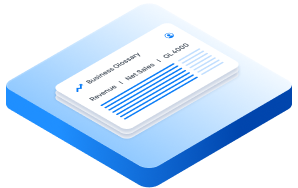
Keboola pulls actuals from every ERP at journal-entry level and maps them into one harmonized chart of accounts — so plan vs. actual compares like-for-like across entities. Variance analysis starts from data, not from a reconciliation exercise.
Unify drivers
Headcount from Workday. Volume from the ERP. Pricing from the CRM. Every driver connected to the financial layer under governed definitions — so a driver-based forecast runs on real inputs, not a structured guess. No manual joining exercise.
Reforecast and simulate
The pipeline is automated, so a reforecast is a model run, not a data collection sprint — weekly or monthly. Then stress it: Monte Carlo simulation, now in preview, returns P10–P90 bands and ranks which drivers move the outcome most. The board gets a range it can plan against, not a point estimate.
Keep watching after approval
Once the plan is locked, Monitoring Agents track revenue growth, margin compression, and OpEx ratio — the drivers your plan depends on. When reality drifts, a signal fires into one stream, with the journal entries behind it. FP&A stops discovering drift at close.
Companies that fixed it
FP&A teams that flipped the 70/30 ratio.


FP&A team spending 70% of time collecting data, not analyzing it.
70% reduction in FP&A reporting time across 9 countries, with 25% of all HQ reporting automated. Rolling forecasts now reflect current actuals, not month-old exports.


Month-end close was the bottleneck of every planning cycle.
70% reduction in close time on harmonized, traceable actuals — implemented in 2 months. Planning now starts from current numbers, not last cycle's exports.
Why Keboola
Anaplan and Planful compete in xP&A — extended planning on whatever data they find. Keboola is iP&A: intelligent planning built on the governed actuals layer those tools assume.
CFOs who already own a planning platform buy Keboola because the platform finally gets harmonized, traceable actuals — and the planning doesn’t stop when the plan is approved.

Questions & answers
Frequently Asked Questions
Everything finance, IT, and procurement will want to know — up front.


Still planning on last quarter’s exports? We will show you what continuous planning looks like on your own data.
The 30 minutes covers where your planning data breaks today — and what weekly reforecasting on traceable actuals would take for your setup.
Resources for CFOs
Insights & conversations
for finance leaders.
Whitepapers, ebooks, implementation playbooks — and conversations with finance leaders operating in multi-entity, PE-backed, and post-acquisition environments.